
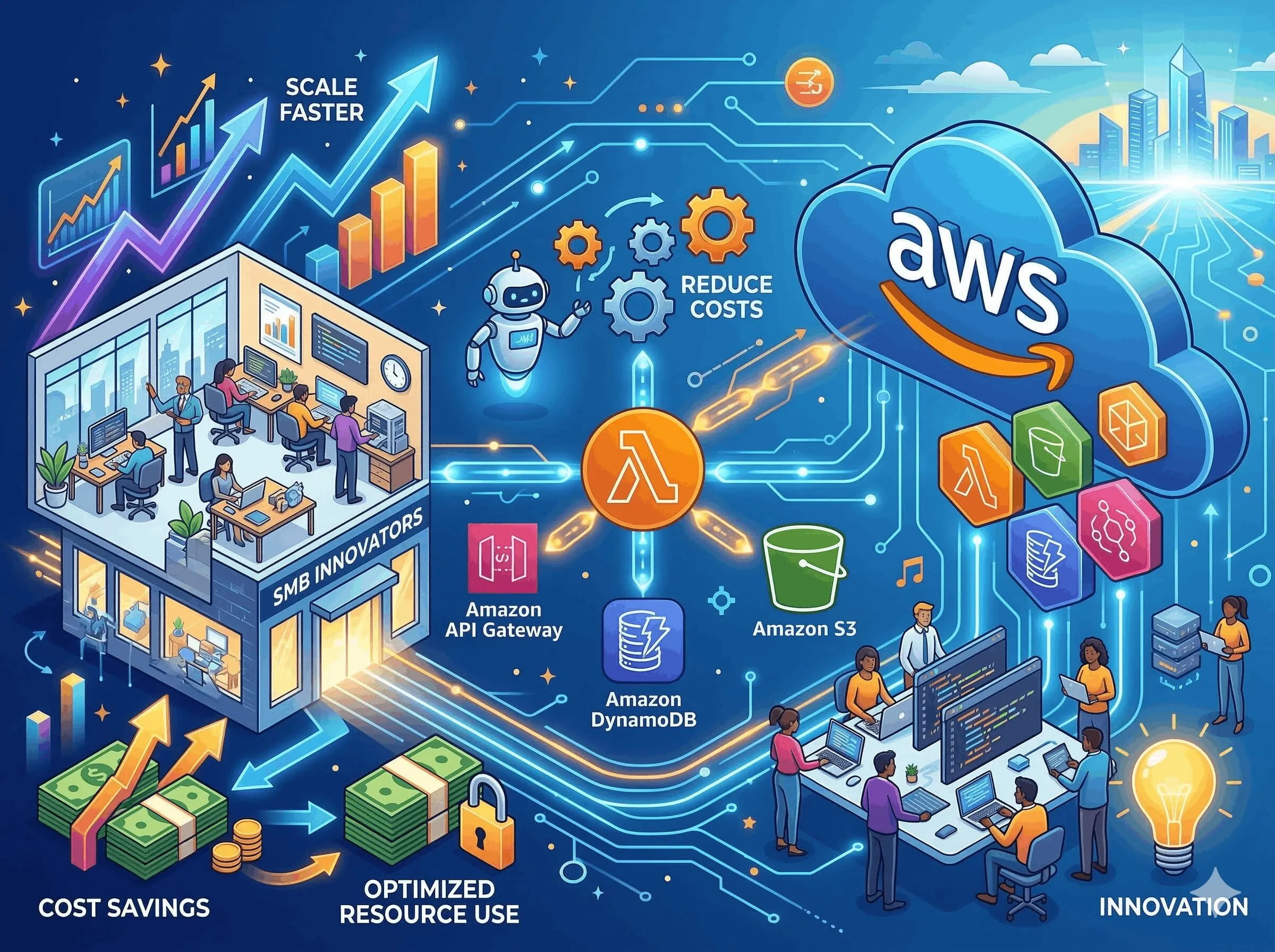
Introduction
For many small and medium-sized businesses, managing IT infrastructure can become a constant challenge. Traditional architectures require businesses to maintain servers, patch operating systems, monitor capacity, and plan for peak demand - all tasks that consume time and resources that could be better spent on growing the business.
This is where serverless architecture offers a transformative approach.
Serverless computing allows businesses to build and run applications without managing servers or infrastructure, enabling teams to focus entirely on delivering value to their customers. Instead of provisioning hardware or managing virtual machines, applications run on demand, scale automatically, and only incur costs when they are actively used.
Powered by services such as AWS Lambda, Amazon DynamoDB, and Amazon API Gateway, serverless architectures are becoming the preferred choice for modern applications - particularly for SMBs looking to innovate quickly without large IT teams.
At DigitalCloudAdvisor (DCA), serverless architecture plays a key role in many of the solutions we design, helping businesses deploy scalable systems while maintaining cost efficiency and operational simplicity.
What Is Serverless Architecture?
Despite the name, serverless does not mean there are no servers. Instead, it means that server management is handled entirely by the cloud provider.
With serverless computing:
- Infrastructure provisioning is automated
- Scaling happens dynamically based on demand
- Businesses pay only for the compute they actually use
- Applications can respond instantly to events and workloads
This model removes the complexity associated with traditional infrastructure management, allowing development teams to focus on building features rather than maintaining servers.
The Challenges of Traditional Infrastructure
Many businesses still rely on traditional architectures built on virtual machines or physical servers. While these approaches were once necessary, they often create operational limitations.
Common challenges include:
Overprovisioning Resources: Businesses must often allocate servers for peak demand even if those resources remain idle most of the time.
Infrastructure Maintenance: Operating systems, security patches, and server monitoring require constant management.
Scaling Complexity: Handling sudden traffic spikes can require additional infrastructure planning and manual intervention.
Increased Operational Costs: Running servers continuously - even during periods of low usage - can lead to unnecessary expenses.
Serverless architectures address these challenges by introducing a more dynamic and efficient computing model.
Key Benefits of Serverless for SMBs
Serverless architectures offer several advantages that make them particularly attractive for small and medium-sized businesses.
Cost Efficiency
One of the most significant advantages of serverless computing is its pay-per-use model. Instead of paying for servers that run continuously, businesses only pay when their applications execute.
This dramatically reduces infrastructure costs and eliminates the need to estimate capacity months in advance.
Automatic Scalability
Serverless applications automatically scale based on demand. Whether handling ten users or ten thousand, the underlying infrastructure adjusts seamlessly without manual intervention.
This ensures businesses can grow without worrying about infrastructure limitations.
Faster Innovation
Without the need to manage servers, development teams can focus entirely on building and improving applications.
This allows businesses to release new features faster, respond quickly to customer feedback, and maintain a competitive edge.
Built-In Security and Reliability
AWS serverless services are built with enterprise-grade security and resilience. Infrastructure maintenance, availability, and patch management are handled automatically by AWS, reducing operational risks.
Core AWS Services Behind Serverless Architectures
Several AWS services form the foundation of modern serverless applications.
✅ AWS Lambda
AWS Lambda allows developers to run code in response to events without provisioning or managing servers. Functions execute automatically when triggered by events such as API requests, database updates, or file uploads.
✅ Amazon DynamoDB
DynamoDB is a fully managed NoSQL database that delivers extremely fast performance and scalability. It allows applications to store and retrieve data with single-digit millisecond latency, even at large scale.
✅ Amazon API Gateway
API Gateway enables secure communication between applications and backend services. It acts as the gateway for web and mobile applications interacting with serverless functions.
✅ AWS Step Functions
Step Functions orchestrate complex workflows by coordinating multiple services and functions into automated processes.
Real-World Applications of Serverless Architectures
Serverless computing is used across many industries and business use cases.
Examples include:
- Inventory management systems
- Real-time analytics platforms
- AI-powered chat assistants
- e-commerce platforms
- automated reporting systems
Because serverless architectures scale automatically and reduce infrastructure complexity, they allow businesses to focus on delivering value to customers.
Serverless in Action: DigitalCloudAdvisor Solutions
At DigitalCloudAdvisor, serverless architecture forms the backbone of many of the solutions we build for our clients.
Our platforms - including ChillManager, Hotel AI Assistant, and our AI-driven Virtual Call Centre - leverage serverless technologies to provide scalable and cost-efficient services.
For example:
- Serverless functions automate backend workflows.
- Managed databases provide real-time operational data.
- APIs connect applications securely across multiple platforms.
This architecture allows these systems to scale effortlessly while maintaining operational efficiency, ensuring businesses can grow without worrying about infrastructure limitations.
Why Serverless Is Ideal for SMBs
Serverless architecture democratizes access to enterprise-grade technology.
Small and medium-sized businesses can now build applications that are:
scalable
secure
cost-efficient
globally accessible
without the need for large infrastructure teams.
This allows businesses to invest more resources into customer experience, innovation, and growth rather than maintaining IT infrastructure.
How DigitalCloudAdvisor Helps Businesses Build Serverless Solutions
At DigitalCloudAdvisor, we specialize in designing cloud-native architectures that leverage the full power of AWS.
Our approach includes:
- identifying opportunities for automation
- designing scalable serverless architectures
- implementing secure and resilient systems
- optimizing costs and performance
- supporting businesses throughout their cloud journey
Our mission is to help organizations move faster, innovate confidently, and deliver better experiences to their customers.
Final Thoughts
Serverless architecture represents a fundamental shift in how modern applications are built and operated.
By eliminating infrastructure management and enabling automatic scalability, serverless computing empowers businesses to focus on what truly matters - delivering value to their customers.
For SMBs looking to modernize operations, reduce costs, and accelerate innovation, serverless architectures provide a powerful path forward.
With the right cloud strategy and expertise, businesses can unlock new levels of agility and efficiency.
✅ Interested in building serverless solutions for your business?
DigitalCloudAdvisor helps organizations design and implement modern AWS architectures that support growth and innovation.
👉 Get in touch to find out more: Contact DigitalCloudAdvisor - AWS Cloud Solutions Experts | DCA